Related Products


How to Set Up a Self-Service Breakfast Station
Short answer: put the plates first, cold items next, then bakery, hot food and finally the egg or noodle station at the far end with the queue flowing in one direction. Allow 600–700 mm of counter per item and one beverage dispenser per 50 guests. The equipment list below uses cereal dispensers, juice dispensers and breakfast chafing dishes.
Recommended flow
- Plates and cutlery at the entrance — the single biggest queue fix.
- Juice, water and fruit next; guests take these while deciding.
- Cereal and dry goods at eye level for children.
- Bakery and toast with a tiered display for visual height.
- Hot line — eggs, bacon, beans, potatoes in chafers.
- Live cooking or made-to-order eggs last, next to the service doors.
Quantities by cover count
| Item | 50 guests | 100 guests | 200 guests |
| Hot chafers (4 qt) | 3 | 5 | 9 |
| Cereal dispensers | 2 | 3 | 5 |
| Juice dispensers (12 L) | 1 | 2 | 4 |
| Toasting / bakery display | 1 station | 1 station | 2 stations |
| Counter length | 3.5 m | 6 m | 11 m |
Counter dimensions that actually work
- 600–700 mm of linear counter per chafing dish or dispenser.
- 900–1,100 mm aisle width for two-way guest traffic.
- 1,200 mm minimum turning radius if guests are likely to push trolleys or wheelchairs.
- Height 900 mm standard; aim a children's cereal dispenser at about 1,000 mm for adult reach.
Holding times for breakfast items
| Item | Hold temp | Practical quality window |
| Scrambled eggs | 140–150°F (60–65°C) | 30–45 min before weeping |
| Fried eggs, bacon | 140–160°F (60–71°C) | 20–30 min; use a heat lamp to keep bacon crisp |
| Baked beans, hash browns | 140–160°F (60–71°C) | 60–90 min |
| Pancakes, waffles | 140–150°F (60–65°C) | 20–30 min under a lamp, uncovered |
| Pastries and croissants | Ambient | Serve from covered displays, refresh hourly |
Common layout mistakes
- Plates in the middle of the line — creates two queues and blocks flow.
- Toast station next to the juice — heat and humidity make crackers and waffles soggy.
- Two-way traffic past the egg station — the slowest point becomes a bottleneck.
- No floor mat under a self-serve line — spills become a slip hazard within minutes.
Staffing and replenishment rhythm
A breakfast line runs on rhythm, not heroics. Assign zones so nothing waits:
| Covers per hour | Staff on the line | Replenish interval |
| Up to 40 | 1 | Every 30 min |
| 40–90 | 2 | Every 20 min |
| 90–150 | 3 | Every 15 min |
| 150+ | 4 plus a runner | Continuous from the kitchen |
Zone assignment that works: one person owns cold and bakery, one owns the hot line, one owns beverages and plates. Temperature checks sit with whoever owns the hot line, logged every hour on the hour. During the final 45 minutes of service, switch to "top-down closing": stop refilling one dish at a time rather than everything at once, so the line still looks full while you reduce exactly what would otherwise be discarded.
Costed example: 80-cover hotel breakfast
A worked example shows how quickly the numbers add up.
| Station | Equipment | Load | Hold target |
| Hot line | 5 × 4 qt electric chafers | Eggs 8 L, bacon 4 L, beans 6 L, potatoes 6 L, sausages 4 L | 140–150°F (60–65°C) |
| Crispy | 1 × double-head lamp at 45 cm | Bacon and hash browns from the hot line | Surface 145–160°F (63–71°C) |
| Cold / cereal | 3 × cereal dispensers, fruit display | 2 kg per tube | Ambient |
| Beverage | 2 × 12 L juice dispensers | 24 L for 80 covers at ~250 ml each | ≤ 41°F (5°C) |
Staffing for that room is two people until 9 a.m. and one after. Equipment total is about 11 pieces, connected load roughly 2.5 kW, and the difference between a good and a poor layout is usually two minutes of queue time per guest.
Cost per cover and where it goes wrong
| Cost line | Typical share of breakfast cost | Control lever |
| Hot food | 45–55% | Batch sizes every 20–30 minutes |
| Bakery and pastry | 15–20% | Covered storage, refresh hourly |
| Beverages | 10–15% | Metered juice service, no ice dilution |
| Dry goods / cereal | 8–12% | Portion-controlled cereal dispensers |
| Waste and loss | 5–10% | Final-hour batching, measured weekly |
The two lines that move fastest are beverages and dry goods — both respond immediately to metered dispensing, typically worth 15–25% on those specific items without guests noticing any reduction.
Frequently Asked Questions
How much counter space does a breakfast buffet need?
About 600–700 mm per item; a 100-cover breakfast usually needs a 6 m counter plus a 900–1,100 mm aisle.
Where should the cereal dispenser go?
After juices and before the hot line, mounted at around 1,000 mm so both adults and children can reach; keep it away from steam sources.
How do I keep crispy items crisp at breakfast?
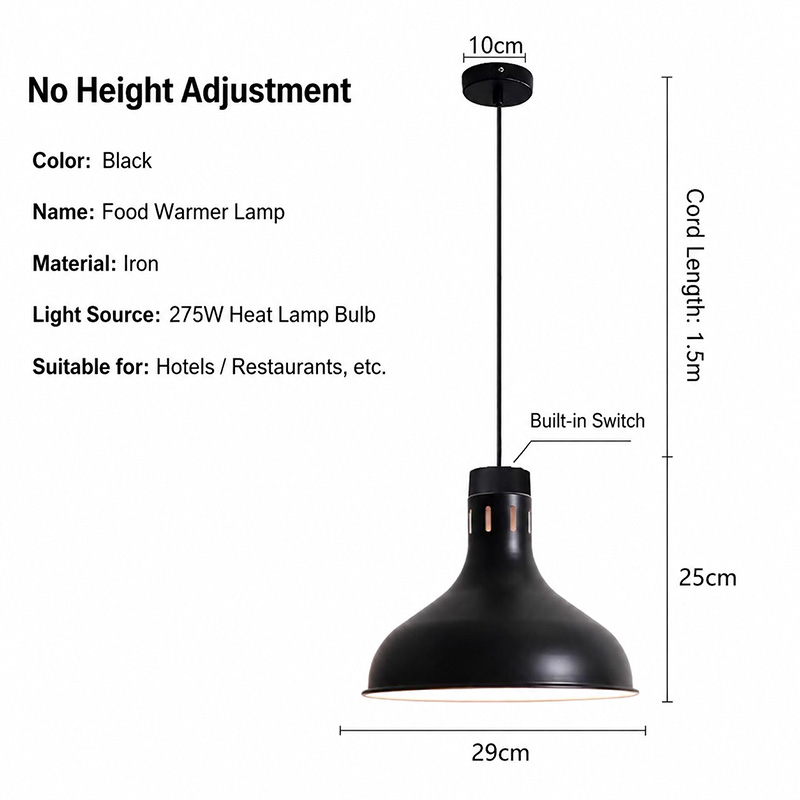
Hold them uncovered under a 250 W heat lamp at 30–45 cm, refreshing every 20–30 minutes. A covered chafer steams bacon and waffles within minutes.
How many beverage dispensers for 100 guests?
Two 12-litre units minimum, ideally three (orange juice, water, and a third rotating option such as iced tea or apple juice).
What is the safest way to serve eggs?
Hold above 135°F (57°C), ideally 140–150°F (60–65°C), refresh every 30–45 minutes and never top up a pan already on the line.
Related reading
Related Articles

How Long Can Food Stay Under a Heat Lamp? The 4-Hour Rule
Food can stay under a heat lamp for up to 4 hours if it stays above 135°F (57°C); quality usually ...
Is Food Under a Heat Lamp Safe? A Straight Answer
Food under a heat lamp is safe when three conditions are met: above 135°F (57°C), under 4 hours, a...

How to Choose the Right Chafing Dish for Your Buffet
Choose the right chafing dish in 6 steps: fuel vs electric, shape, quart size, gauge and lid type. I...
Does a Heat Lamp Produce Radiation? What It Really Emits
A heat lamp emits infrared radiation, which is non-ionizing: photon energy around 0.9–1.6 eV versus...

304 vs 201 Stainless Steel: Which Alloy for Buffet Equipment?
304 (18/8) costs 20–40% more than 201 and resists rust far better because of its 8% nickel; 201 swa...
Chafing Dish Fuel vs Electric: Which Should You Use?
Electric chafing dishes cost about $0.06 per hour to run; canned fuel costs $0.60–1.50. Compare ene...