How Do Heat Lamps Keep Food Warm? A Plain-English Guide
Short answer: a food heat lamp converts electricity into radiant heat — over 90% of it infrared in roughly the 0.7–3 µm band, with wavelengths too long to be ionizing. The rays warm only the food surface to a depth of a few millimetres, and the food conducts the rest inward. A 250 W single-head lamp covers about 600 × 400 mm from 30–45 cm above. See our commercial food heat lamps.
The physics, without the equations
- Electricity heats a filament to roughly 2,500–3,000 K — hence the characteristic red glow.
- The filament radiates. Most of that radiation lands in the short-wave infrared band (about 700 nm to 3 µm). Unlike a convection oven, the lamp does not heat the air in between; it heats what it can see.
- The surface absorbs it and converts it to heat within the first 2–5 mm of food depth.
- Conduction finishes the job — slowly, which is why thick items need stirring or rotation.
- Evaporation takes over eventually. Surface water leaves at 1–3% per 10 minutes, which is why exposed rice and pasta dry out but fried coatings crisp up.
Radiation: what a food heat lamp does and does not emit
| Radiation type | Emitted by a food heat lamp? | Can it ionize matter? |
| Infrared (IR-A, IR-B) | Yes — the main output | No. IR photon energy is far below the ~10 eV needed to ionize |
| Visible light (the red glow) | Yes, small share | No |
| UV-C (germicidal) | No | Yes, but not emitted here |
| Microwaves / radio frequency | No | No |
| X-ray, gamma | No | Yes, but never from an incandescent element |
In plain terms: infrared cannot break chemical bonds, cannot make food radioactive, and does not change its composition. It is the same energy that reaches you from sunlight through a window. The real hazards are heat burns (bulb surfaces run 250–400°C), shattered glass and dried-out food — not radiation.
Choosing wattage: the sizing table
| Serving area to keep hot | Recommended lamp power | Mounting height | Typical installation |
| 400 × 300 mm single plate pass | 150–175 W | 25–35 cm (10–14 in) | Small pass-through, coffee shop counter |
| 600 × 400 mm standard pan | 250 W single head | 30–45 cm (12–18 in) | Countertop heat lamp |
| 1,000 × 500 mm carving board | 2 × 250 W double head | 40–50 cm (16–20 in) | Carving station lamp |
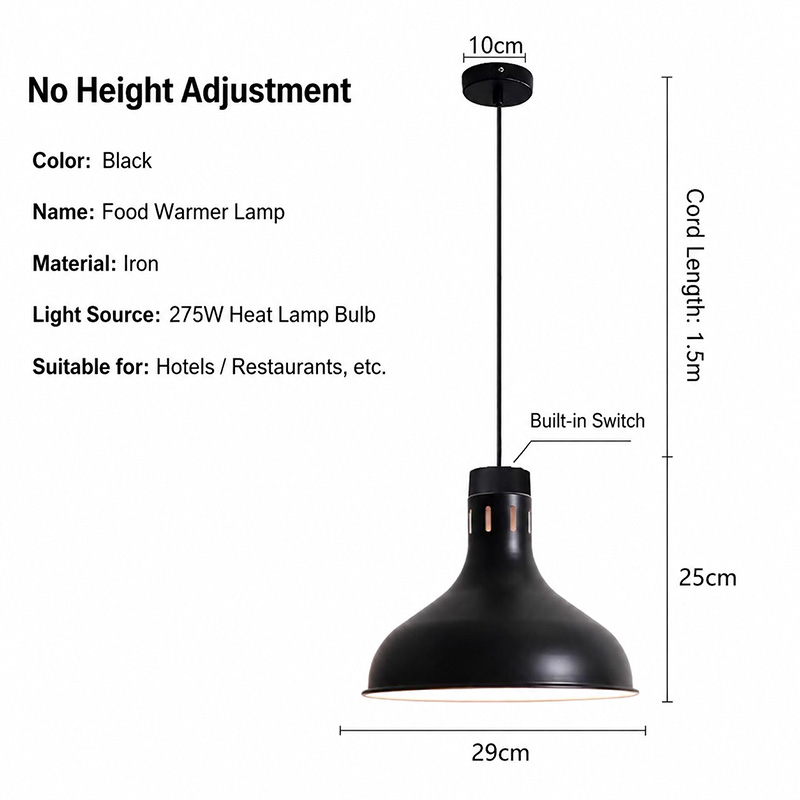
| 1,200 × 800 mm banquet display | 2–3 × 275 W adjustable | 45–60 cm (18–24 in) | Retractable / ceiling-mounted arm |
| Permanent carving counter | Ceiling cluster to suit layout | 60–90 cm (24–36 in) | Ceiling-mounted food heat lamp |
Working rule: around 250 W per 0.25 m² of covered food surface. If the lamp is mounted lower, raise the wattage rather than lowering further, or the top layer will brown while the centre stays cold.
Bulb and fixture choices
- Clear quartz bulb: fastest response, most glare; good for back-of-house pass-through.
- Red / coated bulb: similar heat output with less visual glare; preferred over open buffets.
- Shatter-resistant (PTFE-coated) bulb: specify this wherever open food sits below — glass containment is often a food-safety audit requirement.
- Polished aluminium reflector: directs downward radiation and adds roughly 20–30% effective intensity.
- Adjustable or retractable stem: lets one lamp cover plated meals at 30 cm and tall chafers at 50 cm.
Energy cost
A 250 W lamp draws 0.25 kWh per hour. At $0.15/kWh that is $0.0375 per hour; two heads run about $0.075 per hour. Compare that with $0.60–1.50 per hour for canned chafer fuel — which explains why large operations lamp everything that tolerates dry heat. Full comparison in Heat Lamp vs Chafing Dish.
Frequently Asked Questions
Do heat lamps cook food or only keep it warm?
They hold, not cook. Surface temperatures stabilise around 140–165°F (60–74°C) at the recommended height, whereas cooking typically requires higher heat plus thermal mass. Thin slices can over-brown if the lamp is too close.
How many watts should a food heat lamp be?
250 W for a standard 600 × 400 mm countertop area, 150–175 W for a single-plate pass, and 2 × 250 W or more for a full carving station. Match wattage to the covered area, not to the size of the fixture.
Is a heat lamp safe to leave on for hours?
Yes electrically, but not culinarily. Keep the surface at 135°F (57°C) or above and refresh or discard portions on a schedule — most plated foods pass their quality limit at 20–45 minutes.
Why does food dry out under a heat lamp?
Because radiant heat drives off surface moisture, typically 1–3% every 10 minutes. Lower the wattage, raise the mounting height, cover when not serving, or use a chafing dish for sauced items.
Does a heat lamp emit harmful UV radiation?
Effectively no. The spectral output is infrared plus a little visible red light; there is no UV-C germicidal component, and unlike ionizing radiation it cannot alter the food's structure.
Related reading
- Heat Lamp vs Chafing Dish: which method fits your menu
- Safe food holding temperatures and the 4-hour rule
- All types of commercial food warmers compared
- How long can food stay under a heat lamp?
- Do heat lamps produce radiation?
- How many watts do you need for a heat lamp?
- Ceiling-mounted vs countertop heat lamps
Related Articles

How Long Can Food Stay Under a Heat Lamp? The 4-Hour Rule
Food can stay under a heat lamp for up to 4 hours if it stays above 135°F (57°C); quality usually ...
Is Food Under a Heat Lamp Safe? A Straight Answer
Food under a heat lamp is safe when three conditions are met: above 135°F (57°C), under 4 hours, a...

How to Choose the Right Chafing Dish for Your Buffet
Choose the right chafing dish in 6 steps: fuel vs electric, shape, quart size, gauge and lid type. I...
Does a Heat Lamp Produce Radiation? What It Really Emits
A heat lamp emits infrared radiation, which is non-ionizing: photon energy around 0.9–1.6 eV versus...

304 vs 201 Stainless Steel: Which Alloy for Buffet Equipment?
304 (18/8) costs 20–40% more than 201 and resists rust far better because of its 8% nickel; 201 swa...
Chafing Dish Fuel vs Electric: Which Should You Use?
Electric chafing dishes cost about $0.06 per hour to run; canned fuel costs $0.60–1.50. Compare ene...