Heat Lamp vs Chafing Dish: Which Food-Holding Method to Choose
Short answer: use a chafing dish for anything sauced, steamed or served from a pan, and a heat lamp where crispness matters — fries, carved meat, fried chicken, pastries. A 250 W lamp costs about $0.04/hour; a canned-fuel chafer costs $0.60–1.50/hour. Both methods are covered by our commercial food heat lamps and chafing dish ranges.
Quick decision tree
- Does the food have sauce, stock or rice? Yes → chafing dish. Dry heat will form a skin within 15 minutes.
- Does it lose value when it steams? Yes (fried batter, crispy skin, crisp pastry) → heat lamp.
- Is it a whole muscle being carved to order? Yes → lamp at a carving station, 30–45 cm above the board.
- Do guests serve themselves unpaced? Yes → chafer with roll-top lid (containment and hygiene).
- Do you also need to display it standing? Yes → lamp plus a riser.
Head-to-head comparison
| Factor | Chafing dish | Heat lamp |
| Heat type | Moist indirect (water pan at ~1 in / 2.5 cm) | Dry radiant infrared |
| Energy per hour | Fuel $0.60–1.50, electric $0.05–0.07 | 250–275 W ≈ $0.04 |
| Holding temp achieved | 135–165°F (57–74°C) at the product | 140–165°F (60–74°C) at the surface; check every 20 min |
| Moisture loss | Low | 1–3% per 10 minutes on exposed surfaces |
| Best for | Sauced entrées, rice, pasta, vegetables, eggs | Fried foods, roasted joints, pizzas, pastries |
| Access / serving | Guest self-serve with lid control | Staff-plated or open access — no lid means more airborne contact |
| Setup time | 8–12 min (water, fuel, preheat) | 2–3 min (plug in, set height) |
Mounting height and wattage, in numbers
| Lamp power | Recommended height above food | Coverage area | Typical use |
| 250 W bulb | 30–45 cm (12–18 in) | 600 × 400 mm | Countertop holding, pass-through |
| 250 W double head | 40–50 cm (16–20 in) | 1,000 × 500 mm | Carving station, family-style platters |
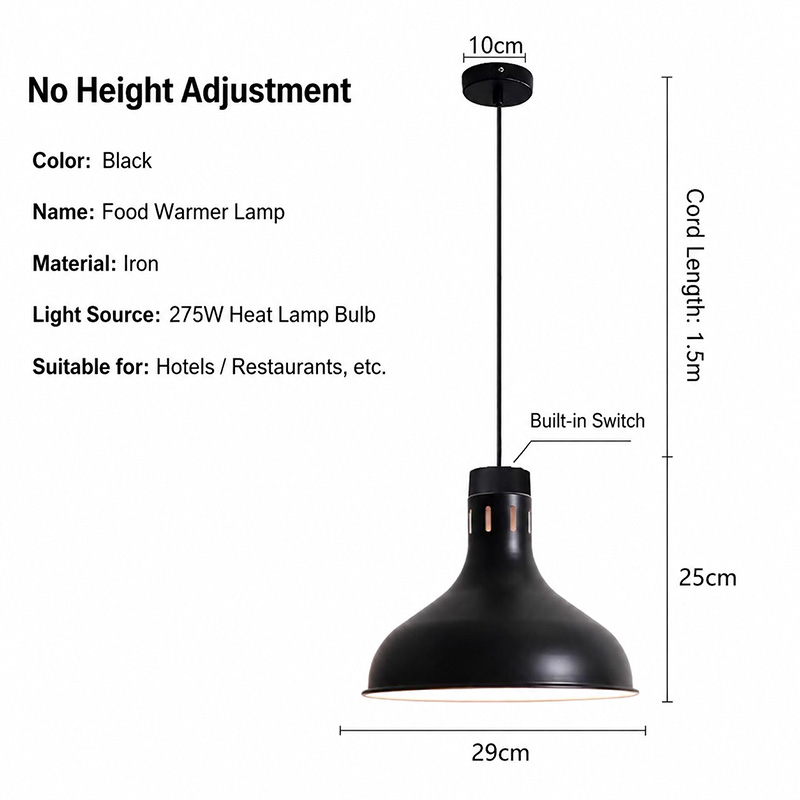
| 275 W with adjustable stem | 45–60 cm (18–24 in) | 700 × 500 mm | Buffet lines with tall chafers underneath |
| Ceiling-mounted cluster | 60–90 cm (24–36 in) | 1,200 × 800 mm | Permanent carving and carving-to-order counters |
Too close and the surface dries and over-browns in minutes; too far and the surface falls back into the danger zone between 40°F and 140°F (4–60°C).
Combining both for the longest quality window
The professional pattern at hotel brunch is to hold the base product in a chafer and hold the plated portions briefly under a lamp. Two temperature logs to keep:
- Chafer internal product temperature ≥ 135°F (57°C), checked every 2 hours.
- Plates under lamps cleared or refreshed within 30 minutes, or the top layer dries.
For crispy items shipped from kitchen to line, a lamp also recovers texture after transport — unlike covered transport boxes, which steam everything.
Safety notes that apply to both
- Every banquet department should log a product temperature at the start of service and every 2 hours afterwards.
- Discard time-held TCS food after 4 hours outside temperature control (FDA Food Code).
- Keep lamp bulbs away from splash zones; use shatter-resistant or coated bulbs where open food sits below.
- Never hold below 135°F (57°C) "just for a few minutes" — that is where Bacillus cereus and Clostridium perfringens multiply fastest.
More detail: safe food holding temperatures.
Two sample station layouts
Hotel breakfast line, 120 seats. Four electric chafers on a 6 m counter: eggs and potatoes at 65 mm depth, beans and sausages at 100 mm. One 250 W heat lamp at the end over bacon and hash browns, mounted 40 cm above the plate rail. Total connected load under 2.5 kW on two circuits.
Off-site wedding, 180 covers. Six fuel chafers with roll-top lids, two wind guards, twelve spare cans, plus one double-head lamp over the carving station at 45 cm. No mains power assumed. Fuel cost for a three-hour service: about 24 cans, roughly $36–60.
| Layout | Holding method | Energy cost per service | Staff touches per hour |
| Hotel breakfast, 120 seats | 4 electric chafers + 1 lamp | $1.50–2.00 | 6–8 |
| Wedding, 180 covers | 6 fuel chafers + 1 double lamp | $36–60 | 14–18 |
The electricity advantage is obvious; the labour gap is the real reason permanent operations go electric.
Frequently Asked Questions
Can a heat lamp replace a chafing dish?
Only for dry, crisp products. Anything with sauce, rice or shredded protein dries unevenly under a lamp and loses 1–3% moisture every 10 minutes on the exposed surface.
Is it cheaper to run a heat lamp than a fuel chafing dish?
Yes. A 250 W lamp costs roughly $0.04 per hour at $0.15/kWh; a chafing fuel can costs $1.20–3.00 for two hours, or $0.60–1.50 per hour.
How high should a food heat lamp hang?
For a 250 W bulb, 30–45 cm (12–18 in) above the food surface; the higher wattage you use, the higher you can mount it. Verify by measuring the food surface temperature, not the air.
How long can food stay under a heat lamp?
Two hours is the practical quality limit for most plated items, and food must remain at or above 135°F (57°C); the regulatory discard point is 4 hours of uncontrolled holding.
Do heat lamps produce radiation that affects food?
They emit infrared — non-ionizing radiant heat, the same band as a toaster or sunlight through glass. It does not make food radioactive and does not alter its chemical structure. Read the full explanation in our heat lamp guide.
Related reading
Related Articles

How Long Can Food Stay Under a Heat Lamp? The 4-Hour Rule
Food can stay under a heat lamp for up to 4 hours if it stays above 135°F (57°C); quality usually ...
Is Food Under a Heat Lamp Safe? A Straight Answer
Food under a heat lamp is safe when three conditions are met: above 135°F (57°C), under 4 hours, a...

How to Choose the Right Chafing Dish for Your Buffet
Choose the right chafing dish in 6 steps: fuel vs electric, shape, quart size, gauge and lid type. I...
Does a Heat Lamp Produce Radiation? What It Really Emits
A heat lamp emits infrared radiation, which is non-ionizing: photon energy around 0.9–1.6 eV versus...

304 vs 201 Stainless Steel: Which Alloy for Buffet Equipment?
304 (18/8) costs 20–40% more than 201 and resists rust far better because of its 8% nickel; 201 swa...
Chafing Dish Fuel vs Electric: Which Should You Use?
Electric chafing dishes cost about $0.06 per hour to run; canned fuel costs $0.60–1.50. Compare ene...